


AuroraZ: How a Phoenix Singer-Songwriter Found Her Voice and Started Over

AuroraZ: How a Phoenix Singer-Songwriter Found Her Voice and Started Over
Sometimes a stage name is branding.
Sometimes it gives you somewhere to go.
For Phoenix singer-songwriter Amy Muñoz, becoming AuroraZ came during a period when she was rebuilding her life after a difficult divorce.
The name was inspired by the aurora borealis: light appearing against darkness. The “Z” completed another idea Amy liked—the possibility that music could illuminate everything from A to Z.
That makes AuroraZ less of an alter ego and more of a creative destination.
Our conversation on The Desert Vibe Podcast became a story about what happens when somebody who has spent years writing music finally decides the stories need to come from her own voice.
It also became a reminder that starting again does not necessarily mean starting from zero.
Sometimes the songs have been waiting for you the entire time.
AuroraZ is now a Phoenix-based independent singer-songwriter whose music centers on connection, resilience, gratitude, emotion, and navigating life's changes. Her 2025 release It Takes a Storm captures many of those themes.
Before AuroraZ, Amy Muñoz Was Already Writing Songs
Amy did not suddenly discover songwriting as an adult.
She had been writing for years.
She played guitar when she was younger and wrote material for musicians and bands in places including Chicago and Tucson. But there was an important separation in her mind between writing a song and being the person who should stand at the microphone and sing it.
She did not consider herself a trained singer.
So she gave songs away.
That arrangement worked until someone challenged the logic behind it.
If these were Amy's experiences and Amy's stories, maybe somebody else could technically sing the notes.
But they could not tell the story in exactly the same way.
A friend eventually made that point clearly enough that Amy had to confront the uncomfortable possibility that the songs might require her voice.
That meant doing the part she had avoided.
Getting onstage.
Phoenix Open Mics Helped AuroraZ Become a Performer
Knowing you wrote a good song does not automatically make standing in front of strangers comfortable.
Amy remembers those first performances being physically uncomfortable.
Nerves.
Shaking.
The vulnerability of singing something personal while people watch.
That is one reason open mic nights can be so important to developing musicians.
They give you repetitions.
The first performance might feel terrifying.
The tenth usually feels different.
Then one night you realize you are thinking about the song instead of thinking about the fact that everybody can see you.
Arizona's open-mic community became part of that progression for AuroraZ.
Beginners can end up sharing the same night with musicians who have been performing for decades. Somebody may play their first original song two slots before a professional musician tests something new.
When the room is supportive, that mixture works.
You learn by watching.
People introduce themselves.
Someone tells you where another open mic is happening.
Eventually you stop feeling like you are visiting the music scene and start realizing you are part of it.
For Amy, returning to music began to feel like coming home.
Why Starting Over Creatively Can Require Community
There is a romantic idea that artists disappear somewhere alone, process everything that has happened to them, and emerge with brilliant work.
Sometimes that happens.
But many creative lives are rebuilt around other people.
Someone invites you to play.
Someone listens to the song.
Someone tells you that you should sing your own lyrics.
Someone remembers your name the next time you walk into the room.
That kind of reinforcement matters when confidence has taken a hit.
AuroraZ's story is especially interesting because the public creative reset followed a private personal one.
The stage name gave that reset an identity, but the Arizona music community gave it somewhere to exist.
Her official artist site now describes AuroraZ as a Phoenix singer-songwriter performing heartfelt original music, while The Desert Vibe lists Amy among its featured Arizona artists.
Old Songs Can Grow Up With the Songwriter
One of the most useful songwriting conversations in the episode came from talking about old material.
Songwriters occasionally discover something they wrote years ago and have one of two reactions.
The first is:
That was actually pretty good.
The second is:
What was I thinking?
Usually both reactions happen in the same song.
Amy does not treat older writing as sacred simply because it came from an earlier version of herself.
Songs can change because the songwriter changes.
Her work-in-progress song “Perspective” is a great example.
Amy originally started the song as a teenager.
Decades later, she returned to it with an adult understanding of the same emotional territory.
Instead of pretending the younger perspective never existed, she found a way to let both versions live inside the same song.
The teenager tells part of the story.
The adult answers from somewhere further down the road.
That creates something you could not have written at either age by itself.
Time becomes one of the co-writers.
Rewriting May Be the Real Songwriting
Musicians sometimes talk about inspiration as if the first draft drops out of the sky completely formed.
Most songs are not that polite.
They need work.
A lyric that sounded profound at midnight may need serious help the next afternoon.
A verse might contain one great line surrounded by seven lines that only existed to get you there.
The chorus may eventually reveal that the entire first verse is about the wrong thing.
Amy's approach reinforces an important idea:
Rewriting is not evidence that the songwriting failed. Rewriting is songwriting.
That becomes even more obvious when revisiting material written years earlier.
You are not trying to preserve a museum exhibit of exactly who you were when the first line appeared.
You are trying to make the strongest song you can make now.
Songwriting Advice: Record Everything
Amy also gave one piece of advice that every songwriter should probably follow:
Record everything.
The melody you assume you will remember tomorrow?
You probably will not.
The lyric fragment that seems too small to matter?
That may be the beginning of a chorus five years from now.
Phones have made this incredibly easy.
A voice memo does not need to sound good.
It can be fifteen seconds of humming.
A strange chord progression.
Half a sentence.
A rhythmic idea.
The point is not to create a finished recording.
The point is to keep the idea from disappearing.
Songwriters accumulate fragments.
Eventually one fragment meets another one at exactly the right time.
What looked like a throwaway suddenly becomes the line that unlocks an entire song.
Co-Writing Forces Songwriters Out of Familiar Habits
Writing alone lets you build a very comfortable creative world.
You use chord changes your hands already know.
You phrase melodies in ways your voice naturally likes.
You structure songs according to instincts you have reinforced for years.
That can become your style.
It can also become a rut.
Amy talked about how co-writing forces her into musical decisions she might not make by herself.
Another writer hears the rhythm differently.
They suggest a chord you would not have reached for.
They hear a lyric from an angle you did not recognize.
Suddenly the song has to negotiate between two musical instincts.
That can be uncomfortable.
Which is exactly why it can be useful.
Co-writing is not about having someone else fix your music.
It is about allowing another creative brain to interrupt your habits.
The result may contain pieces of you that you could not access alone.
It Takes a Storm Turns Change Into Songs
AuroraZ's first release, It Takes a Storm, brings many of these ideas together.
The seven-song project includes “The Outside Looking In,” “Embers,” “Away,” “Bare,” “Gaslight,” “God Laughs,” and “Worthy.” Streaming services list the album as a 2025 release, while AuroraZ's Bandcamp identifies Amy Muñoz as a Phoenix independent singer-songwriter working in an acoustic indie-folk style.

The title itself fits Amy's story.
Change is rarely neat.
Sometimes the thing that moves you onto another path is the thing you never would have voluntarily chosen.
AuroraZ's release page describes It Takes a Storm as being about change and how rarely it arrives easily.
The record was also built with musicians from the Arizona community. Credits include Tim Sadow on violin and viola, Beth Lederman on keys, Marcus Weeden on bass, Jon Rauhouse on pedal steel, Frederic Chao on cello, Dominic Ziccarelli on electric guitar, Bill Engstrom on percussion, and several harmony vocalists. Sean Cooney engineered and mixed the project at 3 Leaf Recording in Phoenix.
That makes the record an individual story told with a community around it.
The Song “Bare” Captures the Fear of Finding Your Voice
One song on It Takes a Storm connects especially well to our conversation.
Without giving away the entire lyric, the song deals directly with the vulnerability of being told that your story requires your own voice and then realizing what that means once you actually stand onstage.
That is the uncomfortable side of authenticity.
Artists often say they want to be authentic.
But authenticity sounds much nicer as an idea than it feels when the thing being exposed belongs to you.
There is nowhere to hide behind another singer.
No distance between writer and performer.
That vulnerability is exactly what can make a song connect.
The thing that makes you uncomfortable may be the thing another listener recognizes immediately.
Travel and a Bigger Musical Community
AuroraZ's ambitions are not limited to finding another Phoenix stage.
Amy talked about travel, songwriting retreats, and the possibility of connecting with musicians internationally.
Desert Vibe's artist profile describes that dream as a nomadic global community of musicians creating and collaborating across borders.
That idea feels like a natural extension of everything else in her story.
Music helped her reconnect locally.
Why stop there?
Open mics, songwriting circles, retreats, and collaborative sessions can create an immediate common language even when musicians come from completely different places.
You arrive with a song.
Somebody else arrives with an instrument.
You figure out the rest.
What’s Vibin’ Across the Arizona Music Scene
After AuroraZ's interview, we moved into What's Vibin' in the Desert, our statewide look at places Arizona musicians can perform, listen, and connect.
This week's roundup included everything from community open mics to bar jams with available backline and other regional opportunities.
We keep this portion of Desert Vibe practical because the small details matter.
Does the venue have amplification?
Do you need to bring an instrument?
When does sign-up begin?
Is it a listening room or a noisy bar?
Do performers usually stay afterward?
A musician trying to become more comfortable onstage needs opportunities to actually get on stages.
Amy's story demonstrates why those rooms matter.
An open mic can look insignificant from the outside.
For the person walking through the door with shaking hands and their first original song, it may be the beginning of an entirely different creative life.
You Do Not Have to Wait Until You Feel Ready
My biggest takeaway from the interview with AuroraZ was how little creative growth seems to care about whether we feel prepared.
Amy did not suddenly receive permission to call herself a singer.
She sang.
Then she kept doing it.
The confidence followed.
She did not throw away every song written by her younger self.
She returned to them and asked whether there was still something worth saying.
She did not keep every musical idea because it seemed immediately important.
She recorded the fragments and let some of them wait.
And she did not treat songwriting as something that had to happen alone.
She allowed other writers and musicians into the process.
That is probably the useful lesson for anyone thinking about returning to music—or beginning much later than they expected.
You do not have to wait for your voice to feel finished.
You find it by using it.
Show up.
Play the open mic.
Save the voice memo.
Rewrite the song.
Call the co-writer.
And if the life you thought you were building suddenly changes direction, maybe the detour contains something worth writing about.
Sometimes it takes a storm.
About the Authors: Emma & James Mattison
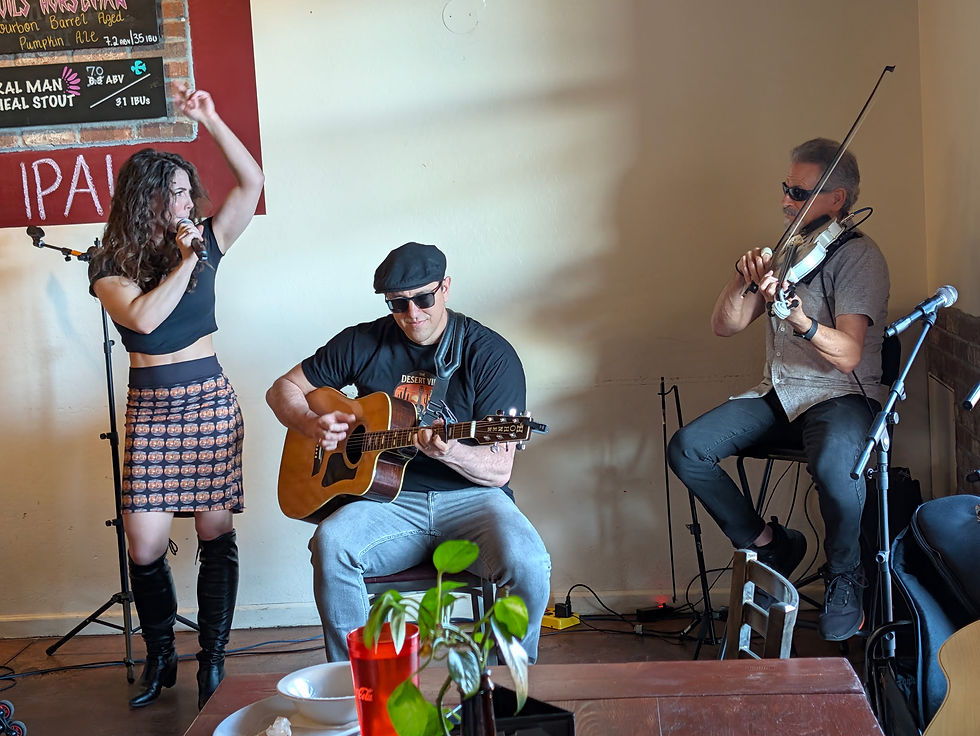
James Mattison is an Arizona guitarist, musician, and blog writer for the Desert Vibe Podcast. He is one half of Emma & James Music, a husband-and-wife Arizona music duo performing original music and select covers while helping document and connect musicians throughout the state's independent music community.
Emma Mattison is the other half of Emma & James Music and manages the Desert Vibe website, social media, marketing, promotions, and online distribution. Her work behind the scenes helps the podcast and the Arizona artists, venues, and music organizations featured on the show reach audiences beyond the studio.
Together, Emma & James use the Desert Vibe Podcast to document Arizona musicians, songwriters, venues, open mics, creative opportunities, and the people helping the state's music community grow.
REFERENCES
AuroraZ Official Website. Official artist information and music links.
AuroraZ Bandcamp. It Takes a Storm track listing, artist biography, musicians, recording credits, and album information.
AuroraZ / HearNow. Streaming links and AuroraZ's description of It Takes a Storm and its theme of change.
Apple Music. AuroraZ artist page and It Takes a Storm track listing.
The Desert Vibe Podcast. Amy Muñoz/AuroraZ featured artist profile and interview listing.
Comments